The White Villages of Andalusia
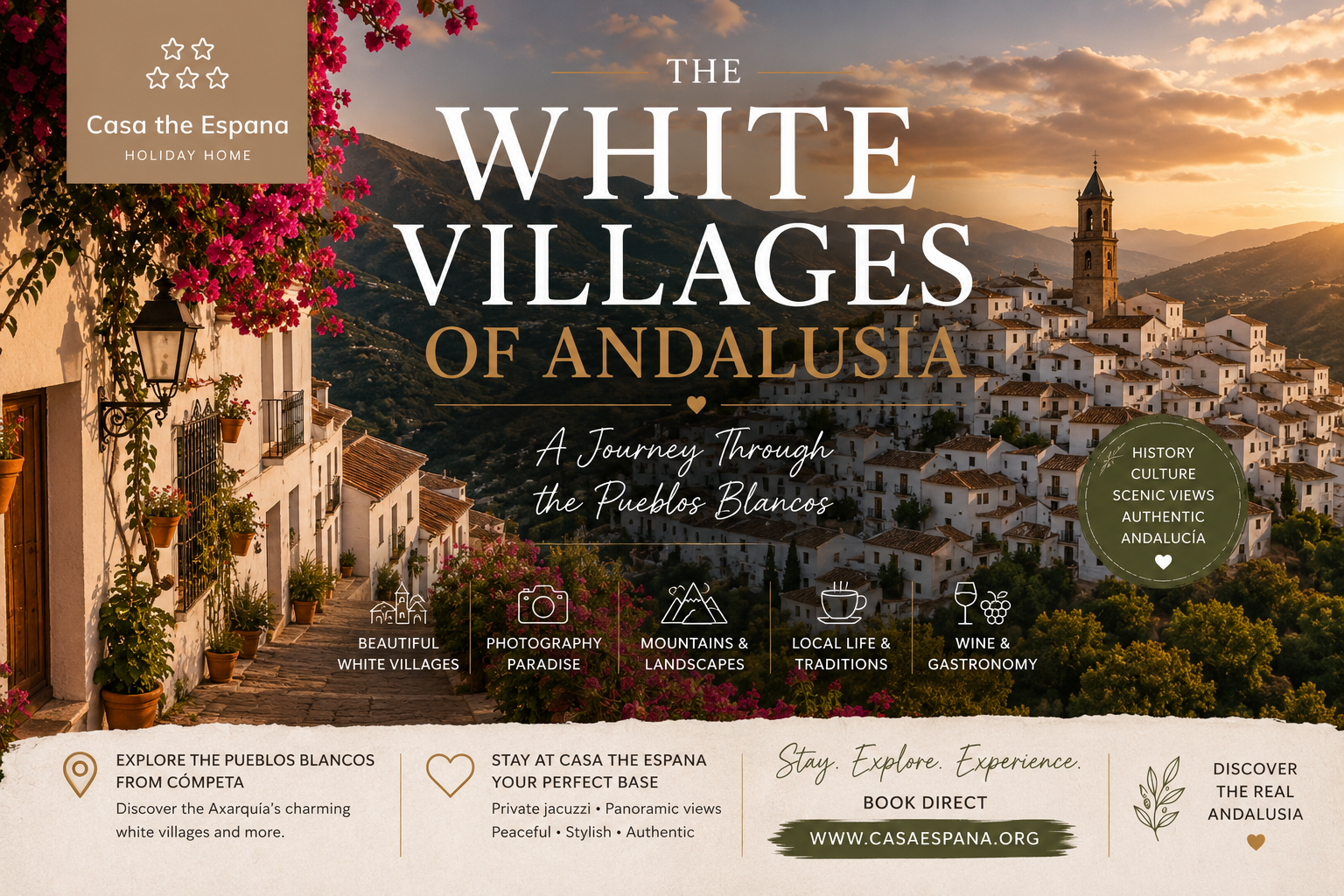
A Journey Through the Pueblos Blancos of Southern Spain
Casa España Journal – Discover the Real Andalusia
White houses climbing steep mountain slopes. Narrow streets disappearing beneath flower-filled balconies. Church towers rising above terracotta roofs. Tiny plazas where neighbours meet for coffee.
Few images represent southern Spain as perfectly as the white villages of Andalusia – the pueblos blancos.
Some have become famous around the world.
Others remain remarkably quiet.
And here in the Axarquía, east of Málaga, you can discover several beautiful white villages within a relatively small area – often connected by spectacular mountain roads.
From our home village of Cómpeta, Casa España provides an ideal base for exploring them.
But this isn't a list of villages to collect.
It's an invitation to slow down.
Park the car.
Walk.
Order a coffee.
And discover the Andalucía that exists between the famous sights.
Why Are Andalusian Villages White?
The characteristic white appearance of these villages is both beautiful and practical.
For generations, buildings throughout southern Spain have been coated with cal – limewash.
The brilliant white surfaces reflect the intense Andalusian sunlight and traditionally helped keep interiors cooler during summer.
Lime also had hygienic properties, which contributed to the tradition of regularly whitewashing homes.
Against Andalucía's deep blue skies, green mountains and dry summer landscapes, the effect is extraordinary.
But the pueblos blancos are much more than a colour scheme.
Their architecture tells the story of centuries of Mediterranean history.
A Landscape Shaped by History
Many Andalusian villages occupy elevated positions that offered strategic advantages in earlier centuries.
Their narrow streets weren't designed for cars.
They twist around hillsides, disappear beneath arches and suddenly open into tiny plazas.
Across the region you'll encounter architectural traces of Roman, Islamic, Mudéjar and Christian history.
Sometimes the clues are obvious.
A church.
A castle.
A minaret.
Sometimes they're simply visible in the shape of a street.
The best way to discover this history?
Walk without trying too hard to find it.
1. Cómpeta – Our White Village
We begin at home.
Cómpeta sits approximately 640 metres above the Mediterranean in the mountains of the Axarquía.
At its heart is Plaza Almijara, dominated by the distinctive tower of the Church of Nuestra Señora de la Asunción.
From the plaza, narrow streets climb between whitewashed houses decorated with colourful doors, ceramic tiles and plants.
Cómpeta has something we particularly value:
It is beautiful, but it is also alive.
This isn't a preserved museum village.
People live here.
Children go to school.
Neighbours meet in cafés.
Local shops open in the morning.
Restaurants fill in the evening.
And international residents live alongside Andalusian families whose connection with the village goes back generations.
Don't Just Visit Plaza Almijara
The plaza is the obvious starting point.
But keep walking.
Some of our favourite corners of Cómpeta are found away from the centre.
Take the street that looks interesting.
Turn uphill.
Then turn around.
The view behind you may be better than the one you were walking towards.
Read next: The Ultimate Guide to Cómpeta
2. Canillas de Albaida – The Quiet Neighbour
Only a short distance from Cómpeta lies Canillas de Albaida.
The two villages are close geographically but have distinctly different personalities.
Canillas is smaller and quieter.
White houses climb towards the upper part of the village, while the surrounding countryside opens towards the mountains.
It is an ideal place for an unhurried morning.
Walk.
Have coffee.
Then continue towards the countryside and Fábrica de la Luz.
Casa España Tip
Combine Cómpeta and Canillas de Albaida if you only have one day.
But don't treat Canillas simply as a quick photo stop.
Give it an hour.
Small villages reveal themselves slowly.
3. Árchez – The Village Beneath the Minaret
Tiny Árchez can easily be overlooked.
Don't.
Its most distinctive landmark is the historic Mudéjar minaret, one of the most remarkable reminders of the area's Islamic heritage.
The village itself is compact and doesn't require a long visit.
That's part of its appeal.
Stop the car.
Walk through the streets.
Look up at the tower.
Have a coffee.
Then continue.
Not every worthwhile destination needs to occupy an entire day.
4. Salares – Moorish Echoes in the Mountains
Continue deeper into the interior and you'll reach Salares.
Surrounded by mountain scenery, this small village retains strong traces of its Moorish past.
The journey itself is part of the experience.
Roads wind through changing landscapes while the Mediterranean tourist centres begin to feel increasingly distant.
Salares works particularly well as part of a slow road trip through several mountain villages.
The goal isn't to tick them off.
The road between them matters too.
5. Sedella – At the Foot of the Sierra
Sedella lies close to the dramatic landscapes of the Sierras de Tejeda.
This is where the white-village experience begins merging with mountain Andalucía.
The village is an excellent destination for travellers interested in:
Hiking
Landscape photography
Traditional architecture
Nature
Quiet village life
Don't arrive looking for a major attraction.
Arrive looking for atmosphere.
You'll find plenty.
6. Sayalonga – Between Mountains and Mediterranean
Sayalonga sits among hills shaped by agriculture.
Olives, vines and subtropical crops form part of the surrounding landscape.
The village is also known for its unusual circular cemetery.
But what we enjoy most is simply the pace.
Sit down.
Order coffee.
Watch village life.
The ability to do very little without feeling that you're missing something is one of the pleasures of rural Andalucía.
7. Cómpeta to the Villages – The Road Is Part of the Journey
This deserves its own section.
When exploring the pueblos blancos, don't think only in terms of destinations.
The mountain roads of the Axarquía are part of the experience.
You'll pass:
vineyards,
olive groves,
old farmhouses,
dry river valleys,
mountain ridges,
goats,
tiny roadside chapels,
and viewpoints that aren't marked on any tourist map.
If something looks interesting and there is a safe place to stop, stop.
Some of our favourite photographs were made between destinations.
8. Frigiliana – The Famous One
We aren't going to pretend Frigiliana is a hidden village.
It isn't.
It has become one of Andalucía's best-known pueblos blancos and attracts large numbers of visitors.
There's a reason.
Its historic centre is extraordinarily photogenic.
Steep cobbled lanes climb between pristine white houses, colourful doors, plants and viewpoints towards the Mediterranean.
But popularity changes how you should visit.
Go Early
If photography matters to you, arrive before the busiest part of the day.
Alternatively, visit later in the afternoon and stay as the day visitors begin leaving.
And most importantly:
Leave the main route.
Many visitors walk through exactly the same streets.
Frigiliana becomes much more interesting when you stop following everyone else.
9. El Acebuchal – The Lost Village
Not far from Frigiliana, but completely different in character, lies El Acebuchal.
Often called The Lost Village, the settlement was abandoned during the difficult period following the Spanish Civil War and remained deserted for decades.
It was later restored and brought back to life.
Today its whitewashed houses sit in a peaceful mountain setting far removed from the atmosphere of the coast.
Getting there is part of the adventure.
This is one of the locations we explore during our private Casa España Acebuchal Land Rover Experience.
Mountain roads.
Photography stops.
Landscapes.
And a village with an extraordinary story.
10. Comares – The Balcony of the Axarquía
Then there is Comares.
You often see it long before you arrive.
The white village occupies a spectacular position high on a rocky hill and offers expansive views across the Axarquía.
Its elevated setting explains why it is often referred to as the Balcony of the Axarquía.
Walk through the village and allow time for the viewpoints.
For Photographers
Try late afternoon.
As the sun lowers, layers of mountains and countryside can create wonderful depth.
Don't only photograph the village.
Photograph what the village sees.
11. El Borge – Moscatel Country
El Borge introduces another important part of the Axarquía story:
wine.
The village is surrounded by a landscape traditionally associated with Moscatel grapes and raisins.
The steep agricultural terraces are visually fascinating and tell you a great deal about how generations have worked this difficult landscape.
This is an area where we'd spend as much time looking at the countryside as the village itself.
12. Almáchar – Rural Axarquía
Nearby Almáchar is another classic Axarquía village surrounded by steep agricultural landscapes.
This part of the region feels very different from the Mediterranean resorts only a relatively short distance away.
The villages are working communities rather than tourist constructions.
And that's precisely the point.
Come here to experience everyday Andalucía.
13. Moclinejo – Gateway to Wine Country
Closer to Málaga, Moclinejo provides another introduction to the region's wine-growing traditions.
The village sits among hills where vineyards have shaped both the landscape and local culture.
For travellers interested in food and wine, this part of the Axarquía deserves considerably more attention than it usually receives.
Beyond the Axarquía
The Axarquía could keep us occupied for weeks.
But Andalucía's white-village culture extends much further.
If Casa España forms part of a longer Andalusian road trip, several other regions deserve attention.
14. Mijas Pueblo
Above the Costa del Sol sits Mijas Pueblo.
It is considerably more visited than many villages in this guide, but its elevated position, traditional streets and views towards the Mediterranean make it worth exploring.
Our recommendation is familiar:
Go early.
Walk beyond the most commercial streets.
15. Casares
The first time you see Casares from a distance, stop.
White houses appear to cascade down a steep hillside beneath the remains of the castle.
It's one of those villages where the wider view can be as impressive as the streets themselves.
For photographers, finding a viewpoint towards the village is essential.
16. Gaucín
Further inland lies Gaucín, surrounded by dramatic countryside.
Its elevated position and historic castle make it particularly attractive for travellers combining white villages with a road trip through inland Málaga.
On clear days, the views can extend astonishingly far.
17. Zahara de la Sierra
Few Andalusian villages have a more spectacular setting than Zahara de la Sierra.
White houses rise beneath a rocky hill crowned by a castle, with a striking reservoir below.
It's increasingly famous – and deservedly so.
This is one of the places where we'd recommend staying long enough to experience changing light rather than simply stopping for twenty minutes.
18. Grazalema
Surrounded by dramatic mountains, Grazalema offers a greener interpretation of Andalucía.
Its location within the Sierra de Grazalema makes it particularly attractive for combining village exploration with hiking and nature.
The region can receive considerably more rainfall than the stereotypical image of dry southern Spain might suggest.
The result is a landscape with its own character.
19. Setenil de las Bodegas
Setenil isn't a conventional pueblo blanco.
And that's exactly why it belongs here.
Parts of the village were built directly beneath enormous rock formations.
Houses and streets appear to disappear under the cliffs.
It has become extremely popular, so timing matters.
Arrive early if you want to experience the village before the busiest period.
Then walk beyond the famous cave streets.
20. Vejer de la Frontera
In Cádiz province, Vejer de la Frontera is one of Andalucía's most elegant white towns.
Its architecture, patios, narrow streets and hilltop setting create a very different atmosphere from the mountain villages of the Axarquía.
If you're travelling towards the Atlantic coast, Vejer deserves a place on the route.
The Alpujarras – A Different Kind of White Village
Travel east towards Granada and the architecture changes.
The villages of the Alpujarras, on the southern slopes of the Sierra Nevada, have a distinctive appearance influenced by their mountain environment and Moorish heritage.
Flat roofs, unusual chimneys and narrow passages distinguish them from many Málaga villages.
Three belong together.
21. Pampaneira
Pampaneira is the first of the famous villages in the Poqueira Gorge.
It's the busiest of the three, but still a beautiful introduction to Alpujarra architecture.
22. Bubión
Continue uphill to Bubión.
Quieter than Pampaneira, the village sits dramatically within the mountain landscape.
For photographers, the relationship between white architecture and the enormous Sierra Nevada surroundings is particularly interesting.
23. Capileira
At the top of the trio lies Capileira.
The views become increasingly dramatic and the high mountains feel very close.
Pampaneira, Bubión and Capileira shouldn't really be treated as three separate checklist destinations.
Make a day of the entire valley.
24. Soportújar – The Village of Witches
Not every pueblo blanco takes itself seriously.
Soportújar has embraced legends of witches, magic and folklore to create one of Andalucía's most unusual village experiences.
It's playful and strange – particularly enjoyable if you're travelling with children or simply want something completely different.
25. The Village We Love Most
After 24 villages, you might expect us to reveal some secret settlement.
We're not going to.
Because our favourite isn't secret at all.
It's Cómpeta.
Not because it's the most famous.
Not because every street is perfectly restored.
And not because it appears on every list of Andalucía's most beautiful villages.
We love it because it's home.
You can have coffee in Plaza Almijara in the morning.
Walk into the mountains.
Meet friends for lunch.
Watch the village change during Noche del Vino.
Find streets you've somehow never noticed before.
And then return to Casa España as the mountains begin to darken.
For us, that's what makes a village special.
Not simply how it looks.
But how it feels when you stay.
How to Photograph the Pueblos Blancos
White villages are deceptively difficult to photograph.
The obvious approach is to point the camera at a beautiful white street.
Try going further.
Look for:
Light and shadow
Strong Andalusian sunlight creates graphic shapes against white walls.
Colour accents
A blue door, red flowers or green plants can transform an otherwise monochromatic composition.
People
Villages are communities. Including everyday life often creates stronger photographs than empty architecture.
Layers
Photograph villages within their mountain landscape.
Details
Tiles, door handles, chairs, plants, signs and textures often tell better stories than panoramic views.
Early and late light
Golden hour transforms white architecture.
Private photography experiences can be arranged through Casa España Photo Experiences for guests who want to explore the region photographically.
A Perfect White Villages Day from Casa España
You don't need to visit ten villages.
We'd rather do this:
09:00 – Breakfast at Casa España
Enjoy the mountain view before leaving.
10:00 – Canillas de Albaida
Walk through the village and have coffee.
11:30 – Árchez
Explore the historic centre and minaret.
13:00 – Lunch
Find a local restaurant.
Don't rush.
15:30 – Mountain Road
Drive slowly through the countryside.
Stop when something catches your eye.
17:00 – Back to Cómpeta
Walk through streets you haven't explored before.
Sunset – Casa España
Jacuzzi.
Mountains.
Moscatel.
Four villages would not necessarily make the day better.
When Is the Best Time to Explore?
Spring
Excellent temperatures, green landscapes and wildflowers.
One of our favourite seasons.
Summer
Beautiful but hot.
Explore villages in the morning and later afternoon.
Use midday for lunch or the Mediterranean.
Autumn
Possibly the perfect season for village road trips.
Pleasant temperatures, softer light and fewer visitors.
Winter
Quiet and highly underrated.
Clear days can provide spectacular visibility and wonderful photography conditions.
Frequently Asked Questions
What are the pueblos blancos?
Pueblos blancos means white villages in Spanish and describes the characteristic whitewashed villages found throughout Andalucía.
Why are the houses painted white?
Traditionally, limewash helped reflect strong sunlight, reduce heat and maintain hygienic building surfaces.
Which white villages are closest to Cómpeta?
Canillas de Albaida and Árchez are among the closest, with several other Axarquía villages easily accessible by car.
What is the most beautiful white village near Cómpeta?
That depends on what you're looking for. Frigiliana is extremely photogenic, Canillas is peaceful, Comares has spectacular views – and our personal choice is naturally Cómpeta.
Do I need a car?
For exploring several smaller villages efficiently, we strongly recommend one.
Can I explore the villages year-round?
Yes. Each season offers a different experience.
Which villages are best for photography?
Cómpeta, Frigiliana, Comares and the mountain villages offer excellent opportunities, but the best photographs often appear in less obvious places.
Can Casa España organise photography tours?
Yes. Private photography experiences can be tailored to your interests and experience level.
Don't Collect Villages
There's a temptation when travelling through Andalucía.
Twenty villages saved on Google Maps.
Five villages today.
Six tomorrow.
Photograph the church.
Photograph the plaza.
Next.
Don't.
Pick fewer places.
Walk further.
Sit longer.
Return when the light changes.
Have lunch.
Talk to somebody.
Get slightly lost.
The pueblos blancos aren't attractions.
They're communities.
Treat them that way and you'll experience a very different Andalucía.
Explore the White Villages from Casa España
Located in the mountains above Cómpeta, Casa España puts you right in the middle of one of Andalucía's most fascinating white-village regions.
Stay for a few days and explore the Axarquía.
Stay for a week and combine villages with:
Mediterranean beaches
Mountain hiking
Photography
Local gastronomy
Wine
Private experiences
Málaga and Nerja
Days where you don't plan anything at all
Then come home to the mountains.
Casa España Holiday Home
For 2–4 guests
Private jacuzzi
Panoramic mountain views
Peaceful terraces
Authentic location
Private experiences
Personal recommendations
Book Direct
Stay in a pueblo blanco. Discover the real Andalusia.
Continue Exploring the Casa España Journal
1. The Ultimate Guide to Cómpeta
Everything you need to discover our home village.
2. The Ultimate Guide to the Axarquía
Our complete introduction to eastern Málaga.
3. 25 Hidden Places in Andalusia
Go beyond the standard tourist itinerary.
4. The Best Beaches Near Cómpeta
From Maro's dramatic cliffs to relaxed Mediterranean beach days.
Next: 6. Hiking Around Cómpeta
Mountain trails, river walks and landscapes surrounding Casa España.